
Capabilities / Engineering
Specialized engineering, from requirement to hardware.
CoolTek focuses on unusual parts, low-volume builds, and technically difficult projects where material behavior, interfaces, manufacturing route, and verification have to be considered together.
Mechanical & structural engineering
Concept evaluation, lightweight structural design, geometry and interface reviews, and manufacturing-aware development for demanding applications.
Prototype & process development
Translate a requirement into a practical fabrication route, identify process risks, develop tooling and trial plans, and iterate toward the first functional article.
Precision finishing & integration
Machined composite features, trimming, drilling, inserts, bonding, fixtures, and integration of specialized assemblies.
Testing & technical evaluation
Define meaningful performance measurements, coordinate material or component testing, and translate results into engineering decisions.
How we work
A practical path from requirement to hardware.
Frame the problem
Geometry, environment, loads, thermal targets, materials, interfaces, quantity, schedule, and acceptance criteria.
Choose the route
Material architecture, tooling, fabrication sequence, interfaces, test plan, and risk-reduction steps.
Fabricate & iterate
Prototype, capture lessons, and refine the process before committing to the final configuration.
Measure what matters
Dimensional, thermal, and application-specific checks with documentation matched to the project.
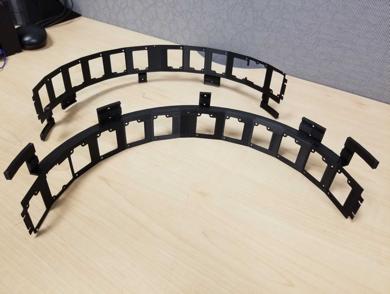
Engineering example / research heritage
Mechanical function and thermal function can be the same part.
Additively manufactured sensor-support prototypes using high-thermal-conductivity material illustrate the kind of cross-disciplinary problem CoolTek is built to address: geometry, manufacturability, thermal transport, and integration treated together.
Examples shown in this section were developed through the Jung Research Group at Purdue University and illustrate the technical R&D heritage that motivated the formation of CoolTek. They are not presented as CoolTek customer deliverables, and their inclusion does not imply Purdue University endorsement of CoolTek.
Challenging environments
Engineering for conditions that change the design.
High radiation, vacuum, launch loads, thermal cycling, low allowable mass, CTE mismatch, or difficult access can dominate a system-level design. CoolTek can treat those constraints as inputs from the start rather than afterthoughts.
Where qualification is required, testing scope and acceptance criteria are defined project by project.
Start with the requirement
Have a difficult part, material, or prototype?
Tell us what the hardware needs to do, the operating environment, quantity, and schedule.